Welcome, brave readers, to a story that will pull at your heartstrings and ignite your sense of justice. This isn’t just a tale of military discipline; it’s a raw, emotional journey of one woman’s fight against a system designed to break her, a testament to courage in the face of overwhelming odds. Get ready to dive into a world where honor is a battlefield, and a single whisper can change everything.
The Day Her Dream Turned to Dust
Captain Elena Rivera stood tall, the midday sun a relentless hammer on her helmet, sweat stinging her eyes as it traced paths down her dust-streaked face. Every muscle in her body screamed, a symphony of exhaustion and triumph. This was it. The final drill of the grueling Advanced Tactical Operations course. The culmination of two years of relentless training, pushing her limits beyond what she thought humanly possible. She’d outrun, outshot, and outmaneuvered men twice her size, endured the sneers, the whispers, the unspoken challenges from an old guard resistant to change. Rivera, an orphan who’d found her family in the uniform, had poured every ounce of her being into this moment. She was a trailblazer, the first woman to reach this stage in the unit’s history, and today, she was supposed to make history.
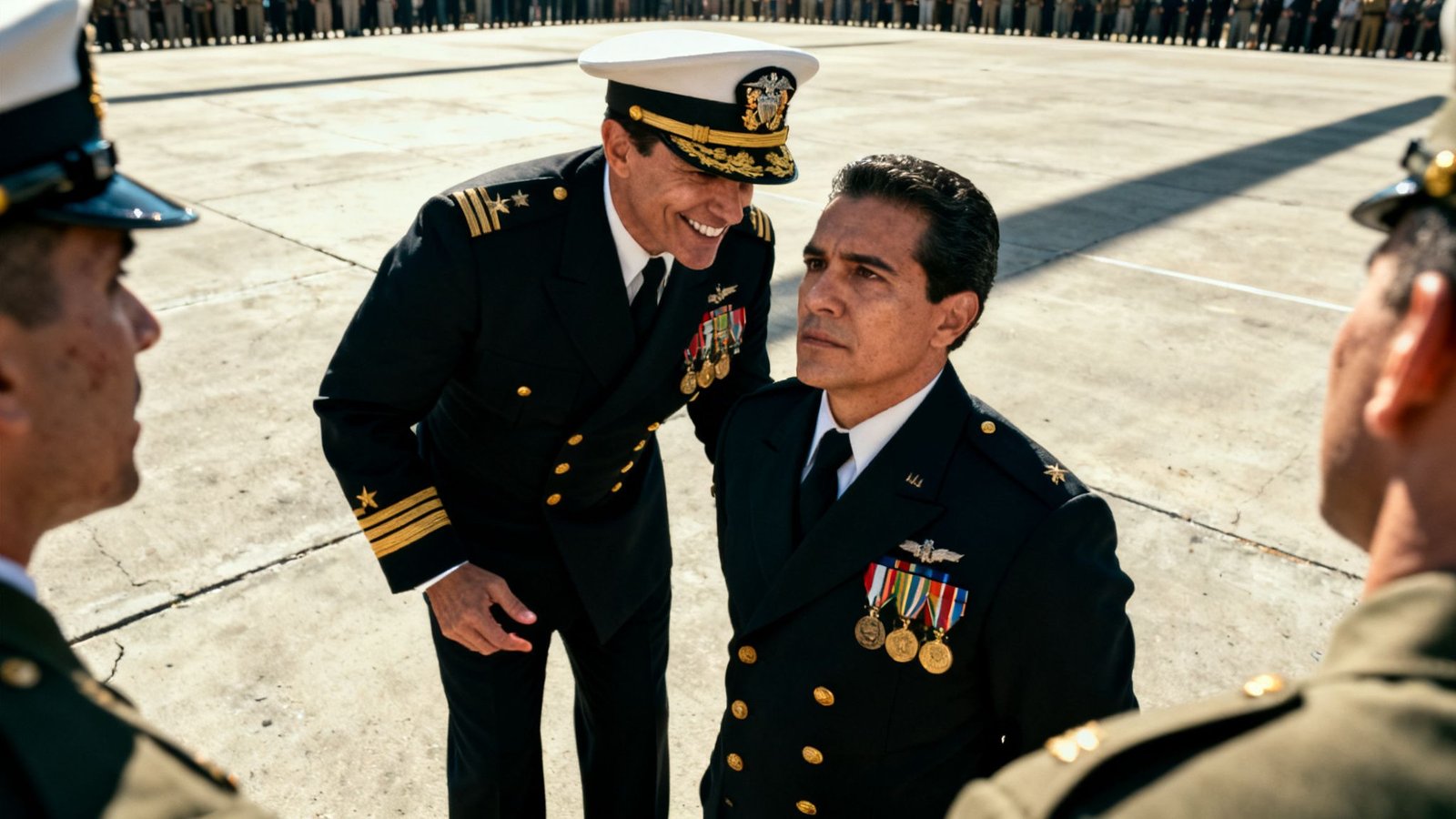
Her gaze swept across the parade ground, the faces of her comrades a blur of anticipation and shared fatigue. They’d pushed each other, cursed each other, and ultimately, respected each other. But then, a shadow fell across the sun-baked concrete, colder than any cloud. General Marcus Vargas. His presence was always an oppressive weight, a dark cloud of traditionalism and barely concealed contempt. He embodied everything Rivera was fighting against – the entrenched sexism, the belief that certain roles were inherently male, the dismissive attitude towards anyone who dared to challenge the status quo. His dark navy dress uniform, heavy with the glint of countless medals, seemed to swell with his arrogance, a stark contrast to the utilitarian fatigue of the trainees.
Vargas stepped forward, his polished boots crunching lightly on the gravel. The air grew thick with tension, the buzzing of unseen insects the only sound. His arm, a rigid rod of authority, shot out, his finger pointing directly at her, like a bayonet aimed at her heart. «Captain Rivera!» His voice, a whip-crack that cut through the silence, accused her of something she knew, with every fiber of her being, was a lie. «Your performance today was not merely unsatisfactory; it was an act of gross insubordination, a blatant disregard for established protocols, and a dereliction of duty that endangered your entire squad!»
The words hung in the air, heavy and poisonous. A public humiliation. Designed to break her spirit, to make an example of her. Her heart hammered against her ribs, a drumbeat of defiance, but her gaze, cold and unwavering, locked onto his. She could feel the stares of the other soldiers, blurred figures in the harsh light, their collective breath held. Every single eye was on her. On Rivera. The injustice burned, a fiery knot in her stomach, but she stood her ground, shoulders back, chin high. She would not crack.
Vargas strode closer, his heavy footsteps echoing the tremor in her chest. He stopped inches from her face, the scent of his expensive cologne clashing with the sweat and dust that clung to her. His eyes, cold and reptilian, bored into hers, a cruel smile twisting his lips as he whispered, his voice a low, venomous hiss meant only for her ears: «You’re digging where you shouldn’t, Captain. Your career, your life… it all ends now, because you saw too much.» The words made her blood run cold, a chilling realization of a danger far beyond a mere disciplinary action. They threatened to unravel everything she believed about honor and duty, hinting at a truth far darker than any insubordination charge. And then, as he pulled back, his eyes daring her to respond, she saw it – a single, almost imperceptible flick of his wrist. A signal. Not to the other soldiers, but to someone hidden just beyond the immediate perimeter, a dark sedan with tinted windows parked innocuously near the perimeter fence. A signal for them to move. Rivera knew, in that split second, her life would never be the same. The accusation was a smokescreen. The whisper, a terrifying truth.
A Web of Lies and a Whispered Threat
The world seemed to tilt on its axis. The roar of blood in her ears drowned out the faint sounds of the parade ground. The General’s words, «You saw too much,» echoed in her mind, a terrifying premonition. What had she seen? When? Her mind raced, sifting through recent patrols, obscure reports, late-night analyses of reconnaissance data. Had she unknowingly stumbled upon something far more sinister than a general’s personal vendetta? The signal, the dark sedan – it wasn’t just about her career anymore. This was about survival.
Within minutes, two grim-faced military police officers, their faces devoid of expression, flanked her. «Captain Rivera, you are relieved of duty and confined to barracks pending a full investigation into charges of gross insubordination and endangering unit personnel.» The words were formal, sterile, but the implications were devastating. She was escorted away, the whispers of her comrades following her like a mournful wind. Some looked away, uncomfortable, others met her gaze with a mixture of pity and fear. Only Sergeant Davies, her second-in-command, a grizzled veteran with eyes that had seen too much, gave her a fleeting, almost imperceptible nod – a silent message of support that ignited a tiny spark of hope in the desolate landscape of her despair.
Confined to her spartan room, the walls seemed to close in. The air, usually thick with the camaraderie of her unit, was now heavy with suspicion. She paced, a caged animal, her mind replaying the General’s words. «You saw too much.» What could it be? Her unit, a highly specialized intelligence and tactical operations squad, often dealt with sensitive data. Had she inadvertently stumbled upon one of Vargas’s illicit activities? He had a reputation for being ruthless, but also for being untouchable, well-connected within the highest echelons of the military and beyond.
A week passed in agonizing slowness. Her communication devices were confiscated. Her access to unit files revoked. Every interaction was monitored. The official charges grew, morphing from insubordination to allegations of leaking classified intelligence, sabotaging equipment, and even collaborating with an enemy operative. The absurdity of it all was maddening. Rivera, who lived and breathed loyalty, accused of treason? It was a meticulously crafted frame-up, designed to not only destroy her career but to utterly discredit her, to ensure no one would ever believe her if she ever spoke out.
One evening, a faint tapping on her window startled her. It was late, the barracks quiet. She peered through the reinforced glass to see Sergeant Davies, a shadow against the moonlit wall. He motioned for her to open it. «Rivera,» he whispered, his voice gruff but urgent, «you’re in deep. Deeper than you think. Vargas isn’t just trying to get rid of you; he’s trying to silence you. For good.»
«What did I see, Davies?» she asked, her voice a strained whisper. «What is he hiding?»
Davies hesitated, glancing over his shoulder. «Remember that joint exercise three months ago? The one near the border, ostensibly for counter-insurgency training? You were tasked with analyzing satellite imagery for troop movements.»
Rivera nodded, a flicker of memory. «Yes, I flagged some unusual cargo plane activity. Civilian planes, flying highly irregular routes, always near the same remote landing strip.»
«Exactly,» Davies confirmed. «You filed a report, but it was buried. Vargas himself signed off on dismissing it as ‘anomalous civilian traffic, not relevant to military operations.’ But it was relevant, Rivera. Extremely relevant. Those weren’t civilian planes. They were military-grade cargo planes, operating under civilian call signs, moving… well, let’s just say, highly illegal cargo. Weapons. High-grade, black market weapons, being funneled through our territory, right under our noses.»
Her blood ran cold. Arms dealing. That explained the «you saw too much.» She had unknowingly stumbled upon a massive, illicit operation, likely involving international players, with General Vargas at its head. «But why me? Why now?»
«Because you’re too good, Captain,» Davies said, a hint of admiration in his voice despite the grim situation. «You don’t miss details. You question everything. And you were getting too close to a promotion that would have given you access to even more sensitive intelligence. He couldn’t risk it. This final drill was just his excuse, a public spectacle to mask the real agenda.» He then handed her a small, encrypted data chip. «This is everything I could pull. Old logs, flight plans, communication intercepts. It’s not much, but it’s a start. There’s a contact, a journalist named Elias Thorne, based in the capital. He’s been investigating military corruption for years. He might be able to help, but he’s a long shot. And Rivera… be careful. Vargas has eyes everywhere. And he plays dirty.» With that, he melted back into the shadows, leaving Rivera with a tiny chip, a glimmer of hope, and a crushing weight of fear.
The Truth Buried Under Medals
The next few days were a blur of solitary confinement and intense mental strategizing. Rivera meticulously reviewed the data chip Davies had given her, using a hidden, old tablet she’d kept for emergencies. The information was fragmented, coded, but slowly, a horrifying picture began to emerge. The flight logs confirmed Davies’s suspicions – a network of «ghost» flights, moving between remote airfields in neighboring countries and a secluded military-owned airstrip deep within their own territory. Communication intercepts, heavily encrypted, contained veiled references to «packages» and «deliveries» and «the General’s cut.» It wasn’t just arms dealing; it was a sophisticated, international black-market operation, likely involving state-of-the-art weaponry, siphoned off from official inventories or acquired through illicit channels, then sold to rogue states or terrorist groups. The sheer scale was staggering, and the implications for national security, catastrophic.
Her heart ached with betrayal. General Vargas, a man draped in medals, a supposed guardian of the nation, was a traitor, enriching himself by endangering countless lives. The very uniform she wore, the institution she revered, was being corrupted from within. The weight of this revelation was immense, but it also fueled her resolve. She wasn’t just fighting for her career anymore; she was fighting for justice, for the integrity of her country.
Her opportunity came during a scheduled interrogation. She was escorted to a small, windowless room, her interrogator a stern-faced colonel who clearly believed Vargas’s narrative. Rivera, however, saw an opening. She feigned a sudden, severe dizzy spell, collapsing dramatically. In the ensuing confusion, she managed to swipe a small, unsecured military-issue burner phone from the colonel’s belt. It was a risky move, but desperation was her only ally.
Back in her room, heart pounding, she remembered Davies’s contact: Elias Thorne. She typed the name into the phone’s browser. It took precious minutes, but she found his contact information. A few terse, coded messages later, a response came: «Meet me at the old clock tower in the city, midnight. Come alone. Don’t be followed.»
Escaping the barracks was another challenge. She knew the patrol routes, the blind spots, the shift changes. Under the cover of a moonless night, using her elite training, she scaled a perimeter wall, her movements fluid and silent. The city was a sprawling labyrinth of neon lights and shadows. She moved like a phantom, her military instincts guiding her through alleyways and deserted streets, a civilian coat hastily acquired from a laundry bin her only disguise.
The clock tower loomed, its ancient face a silent witness to the city’s pulse. Elias Thorne was already there, a gaunt figure with piercing eyes, hunched over a steaming cup of coffee. He looked exactly like the weary, truth-seeking journalist Davies had described. «Captain Rivera,» he greeted, his voice low and gravelly. «I’ve heard things. Nasty things. About Vargas, about you.»
Rivera didn’t waste time. She pulled out the data chip. «This is everything. Flight logs, coded intercepts, proof of a massive arms trafficking operation led by General Vargas. He framed me because I unknowingly got too close.»
Thorne’s eyes widened as he examined the chip. «This… this is explosive. If this is real, it’ll bring down more than just Vargas. It’ll shake the foundations of this entire institution.» He looked at her, a flicker of genuine concern in his gaze. «You know what you’re up against, right? Vargas is powerful. He’ll stop at nothing to protect his empire.»
«I know,» Rivera said, her voice steady. «But I can’t let him get away with it. My unit, my country… they deserve better.»
Thorne nodded slowly. «Alright, Captain. I’ll help you. But we need more. We need undeniable, irrefutable proof. Something that can’t be buried. A live recording, a direct witness, a confession. Something that screams ‘Vargas’ in every headline.»
They began to formulate a plan. Thorne had an informant, a disillusioned former aide to Vargas, who had seen enough to confirm the general’s involvement but was too terrified to speak out publicly. He was their key. The aide, known only as «Echo,» had access to Vargas’s private office, where the general kept a physical ledger of his transactions. If they could get that ledger, it would be irrefutable. But Vargas’s office was a fortress, protected by state-of-the-art security and loyal guards. It was a suicide mission.
One Last Stand Against the Shadows
The plan was audacious, bordering on insane. Rivera, with Thorne’s help, would infiltrate the military headquarters, specifically Vargas’s highly secured office. Echo, the informant, would provide them with a window of opportunity: a specific time when Vargas would be at a mandatory, high-level security briefing, and when a particular security camera would be undergoing routine maintenance. It was a narrow, dangerous gap, a mere 15 minutes to get in, retrieve the ledger, and get out.
«This is madness, Captain,» Thorne had warned, his face pale. «If you’re caught, it’s not just a court-martial; it’s a black site, or worse.»
«I have no other choice,» Rivera had replied, her resolve iron-clad. «They’ve taken everything else. They won’t take my honor.»
The night of the infiltration was a symphony of tension. Thorne, using his network, had acquired a military uniform for Rivera, allowing her to blend in, at least superficially. He waited outside in a discreet van, ready to be her getaway driver and, more importantly, to transmit any evidence she acquired directly to a secure international server, making it impossible for Vargas to suppress.
Rivera moved through the labyrinthine corridors of the headquarters, her heart a drum against her ribs. Every shadow seemed to hold a threat, every distant sound a potential alarm. She bypassed two layers of digital locks, her fingers flying across keypads, recalling her training in cryptographic analysis. The third lock was physical, a biometric scanner. She knew Vargas often used a particular aide to access his office. She had seen the aide’s fingerprints on a coffee cup discarded in a bin outside the general’s office just hours before. With a piece of tape and a steady hand, she managed to lift a partial print, carefully transferring it to a small, flexible film. It was a long shot, but it worked. The heavy steel door hissed open, revealing the General’s sanctum.
The office was opulent, a stark contrast to the utilitarian barracks. Dark wood, leather furniture, and a wall adorned with framed commendations and, of course, more medals. A large mahogany desk dominated the room. Rivera moved with practiced efficiency, her eyes scanning for the ledger. She knew Vargas was meticulously organized, almost obsessively so. It wouldn’t be hidden in plain sight, but it wouldn’t be inaccessible either. Her gaze fell on a heavy, antique globe on a stand in the corner. She remembered a detail from Davies’s intel: Vargas had a fascination with old world maps and hidden compartments. She tested the globe, and with a soft click, a small, cleverly concealed drawer sprang open from its base. Inside, bound in dark leather, was the ledger.
As she reached for it, a sudden, sharp click echoed from behind her. «Well, well, Captain Rivera. I knew you couldn’t resist. You’re predictable, for all your bravado.»
General Vargas stood in the doorway, a chilling smile playing on his lips, a small, silenced pistol held loosely in his hand. His eyes, devoid of any warmth, sparkled with triumph. «You really thought you could outsmart me? I knew Echo would betray me. He’s always been weak. This ‘security briefing’ was a ruse, a bait for a very stubborn fish.»
Rivera froze, her hand hovering over the ledger. Her mind raced, assessing the situation. She was unarmed. Vargas had the element of surprise. «You’re a traitor, General,» she said, her voice steady despite the tremor in her hands. «You’ve betrayed your oath, your country.»
Vargas chuckled, a dry, humorless sound. «Oaths are for fools, Captain. Power is the only currency that matters. And you, my dear, are about to become a very inconvenient loose end.» He raised the pistol, aiming it directly at her chest. «Any last words, Captain? Or perhaps you’d like to beg?»
Just then, a sudden, frantic banging erupted from the office door. «General Vargas! We have a breach in the main server room! Someone’s attempting to upload classified data!» It was a guard, his voice laced with panic.
Vargas’s eyes flickered, a momentary distraction. «What? Who?»
That was all Rivera needed. In a blur of motion, she lunged, not for the ledger, but for Vargas’s arm. Her military training kicked in, a brutal, efficient dance of self-defense. She twisted his wrist, forcing the pistol to discharge harmlessly into the ceiling. The unexpected shot echoed, loud and jarring in the confined space. Before Vargas could recover, she slammed her elbow into his jaw, sending him stumbling backward. He hit the desk with a grunt, momentarily disoriented.
Rivera didn’t hesitate. She grabbed the ledger, tucked it into her uniform, and sprinted for the door. The guard was still there, looking bewildered. «He’s compromised!» she shouted, pointing at Vargas, who was now struggling to regain his footing, a furious snarl on his face. «He’s the one leaking information! Get him!»
Confusion reigned. The guard, torn between her urgent command and Vargas’s furious roar, hesitated. But Rivera was already gone, racing down the corridor, the ledger clutched tightly against her chest. She could hear alarms blaring now, the entire facility erupting into chaos. She knew Vargas would quickly regain control, but she had bought herself precious seconds. She reached the exterior of the building, where Thorne’s van was idling, engine running. She burst through the emergency exit, diving into the passenger seat as Thorne floored the accelerator.
«Did you get it?» Thorne yelled over the screech of tires.
Rivera pulled out the leather-bound ledger, its pages filled with neat, incriminating handwriting. «Every last detail. It’s all here.»
Thorne grinned, a wild, triumphant expression. «Then let’s make sure the world knows.» As they sped away, the military headquarters shrinking in the rearview mirror, Rivera saw flashing lights converging on the building. The chase was on. But the truth, finally, was out.
Justice Forged in Fire
The escape was harrowing. Thorne, a former rally driver in his youth, navigated the city streets with reckless abandon, weaving through traffic, taking shortcuts through narrow alleyways, all while on the phone, coordinating with his network. Rivera, still adrenaline-fueled, began taking photos of every page in the ledger, sending them through Thorne’s encrypted satellite uplink. Each click of the camera was another nail in Vargas’s coffin.
Within hours, Thorne’s colleagues, journalists from across the globe, had copies of the ledger. The story broke simultaneously in multiple languages, erupting like a volcano. The headlines screamed: «General Vargas Exposed: Arms Trafficking Ring Implicated,» «Military Corruption Scandal Rocks the Nation,» «Captain Rivera: Whistleblower or Traitor?»
The initial reaction was a firestorm of controversy. The military, caught completely off guard, tried to deny, to deflect, to discredit Rivera. They issued warrants for her arrest, labeling her a deserter and a traitor, citing the original charges Vargas had fabricated. But the evidence, thanks to Thorne’s immediate dissemination, was already out there, undeniable and damning. The detailed transactions in the ledger, the coded names, the dates, the specific weapon types – it was all there, meticulously documented by Vargas himself.
As the international press hammered the story, the pressure became immense. Foreign governments began demanding answers, as some of the weapons implicated in the ledger had been traced to recent conflicts in volatile regions. The nation’s own intelligence agencies, once loyal to Vargas, were forced to confront the undeniable truth. Sergeant Davies, seeing the global outcry, finally stepped forward, corroborating Rivera’s account and providing additional evidence he had meticulously gathered over the years, risking his own career and freedom.
The tide turned swiftly and decisively. With multiple independent news organizations confirming the ledger’s authenticity and the mounting international pressure, the military could no longer maintain its cover-up. An independent judicial commission was immediately formed. General Marcus Vargas was stripped of his rank, his medals, and arrested on multiple charges including treason, arms trafficking, corruption, and attempted murder. His network, both within the military and internationally, began to unravel, leading to a cascade of arrests and convictions.
Rivera, initially a fugitive, was eventually exonerated. The charges against her were dropped, and she was hailed as a hero. But the path to justice had left its scars. The public humiliation, the fear for her life, the betrayal by a man she once looked up to – it all weighed heavily on her. She chose to leave active duty, not out of bitterness, but out of a need for a different kind of service. She joined a newly formed independent oversight committee, dedicated to rooting out corruption within the armed forces, ensuring that no soldier would ever have to face what she did again.
Her story became a legend within the military and beyond. A testament to integrity, courage, and the unwavering belief in truth. She had lost her place on the parade ground that day, but she had found a far greater purpose, forging a path for true honor. The uniform, once a symbol of betrayal, now represented something more profound: a commitment to justice, no matter the cost. Elena Rivera had not just fought a corrupt general; she had fought for the soul of her institution, proving that even a whisper of truth, when amplified by courage, could shatter the most entrenched shadows of power. Her name, once whispered in contempt, was now spoken with reverence, a beacon for all who dared to stand against injustice.